
October Review: Spams & Scams – How AI is Reshaping Trust and Identity
On 12th October 2026, members and first-time guests gathered at Rudding Park for an evening dedicated to tackling one of the most pressing challenges facing the modern economy.
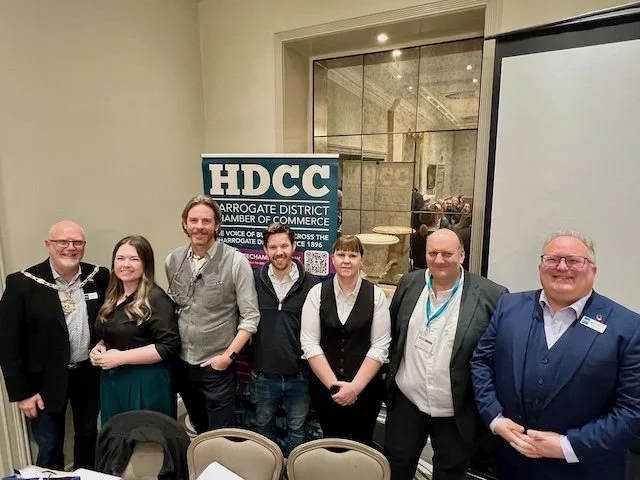
Scams & Spams Meeting
With generous hospitality provided by Matthew Mackaness and his team, the room buzzed with lively networking before everyone took their seats for an insightful and practical multi-perspective briefing.
The AI Scam Revolution (Sam Oakes & Louise Terzza)
Sam Oakes from GOBO Creative and Louise Terzza from Time Together opened the session by confronting the rapid transformation of digital crime. Artificial intelligence has not invented fraud, but it has completely rewritten the rulebook when it comes to speed, quality, cost and scale. Fraudsters are no longer reliant on clunky email templates with glaring spelling mistakes; instead, autonomous AI agents and large language models are being deployed to craft bespoke, flawless communications that mirror legitimate businesses with terrifying accuracy.
The scale of the threat was brought home by recent Malwarebytes data shared on screen. An extraordinary 88 per cent of respondents have now encountered an AI-driven scam, while 85 per cent admit it is becoming difficult to distinguish fraudulent messages from authentic ones - up sharply from 66 per cent last year. Furthermore, 84 per cent say that convincing video evidence can no longer be taken as proof of reality. Highlighting real corporate vulnerability, Sam cited the widely reported case of engineering giant Arup, where a finance employee was deceived into transferring £20 million after attending a video conference populated entirely by deepfake recreations of senior company executives.
To prove how accessible this technology has become, Sam and Louise showcased a deepfake video of Chamber President Phill Holdsworth. In the video, "Phill" addressed members directly, claiming the Chamber had updated its banking details and requesting payments to the new account, before the video transitioned into him singing Ilkley Moor Baht 'at.
Louise explained how everyday social media sharing means our digital identities have effectively become raw data waiting to be harvested and exploited. She shared several real-world stories submitted anonymously by Chamber members, including an employee tricked by a fake Google login into executing ransomware commands, a small business subjected to relentless payment demands after a bogus £250 school book appeal, a digital marketer hit with an authentic-looking Meta compliance warning within 24 hours of running an ad campaign and an individual whose bank account was frozen after falling for a deceptive TikTok review scheme. Concluding the opening segment, Louise reminded the audience that falling for modern fraud is not a sign of foolishness, but of being caught off-guard in a vulnerable human moment.
The Mental Toll and Overcoming Shame (Ben Groves)
Ben Groves of Flux Therapy shifted the room’s focus to the emotional aftermath of falling victim to fraud. Drawing on his clinical experience supporting individuals through trauma, Ben unpacked the profound psychological burden carried by individuals and business owners who find themselves targeted. When an attack strikes, the immediate financial worry is almost always compounded by intense self-blame, with victims suffering from intrusive thoughts such as feeling foolish, fearing they have let everyone down and dreading the judgement of their colleagues.
Research shared during the session revealed that the vast majority of scam victims feel intense embarrassment and anger toward themselves, which often drives them to keep the incident entirely secret. Ben drew an important distinction between guilt and shame. While guilt focuses on behaviour - acknowledging that you made a mistake - shame attacks personal identity, convincing the individual that they are the mistake.
To help navigate these natural emotional reactions, Ben presented a five-step recovery framework consisting of: Containment, Naming the emotion, Separating identity from the event, Disclosing the experience to trusted peers and Integrating the lesson constructively. For business leaders supporting an affected colleague or family member, his advice was equally grounded: name the situation plainly, do not force them to repeatedly relive the trauma, resist the urge to rush into false reassurance or immediate problem-solving, and actively separate legal responsibility from personal blame. Ben provided a Padlet QR code connecting attendees to free emotional support resources for anyone needing guidance.
Putting AI on Your Side (Chris Dickinson)
Chris Dickinson from ASE Computer Services took to the stage to offer practical IT defence strategies, showing how businesses can turn artificial intelligence into an ally rather than an adversary. Chris pointed out that AI is already silently protecting us within enterprise systems like Microsoft 365, online banking platforms, and endpoint protection suites such as Sophos, where behavioural engines and Microsoft Entra ID continuously analyse sign-in signals in real time to intercept suspicious access attempts.
Rather than fearing AI, Chris demonstrated how business owners can use tools like ChatGPT as an everyday second opinion. In one live demonstration, he showed how an AI tool spotted a clever lookalike phishing domain targeting NinjaOne where the letters 'r' and 'i' were combined to mimic an 'm', a subtle trick easily missed by a rushed member of staff. He also demonstrated how a manager can use generative tools in under ten minutes to build tailored, friendly cybersecurity quizzes for staff, turning dry compliance training into engaging monthly micro-learning sessions.
His overarching security mantra was clear: do not waste energy trying to determine whether digital media is fake; verify the channel instead. In an era of cloned voices and spoofed numbers, trust belongs to the channel of communication, never the incoming message itself. He urged businesses to rely on habits that AI cannot manipulate, such as calling back on independently verified numbers, requiring dual sign-off on payments exceeding a set threshold, establishing an agreed verbal code word for urgent payment instructions and treating artificial urgency and secrecy as the primary red flags of fraud.
Chris concluded with three concrete actions for attendees to take straight away: turn on Multi-Factor Authentication across all email and banking accounts, agree on an urgent verification code word with the person who pays the company bills, and foster a strict no-blame reporting culture where employees never conceal a potential mistake out of fear. For immediate assistance, he reminded everyone to forward suspicious texts to 7726, forward phishing emails to report@phishing.gov.uk, call 159 if an unexpected call claims to be from a bank, and download the free National Cyber Security Centre Small Business Guide.
Law Enforcement and Fully Funded Support (Claire Allinson)
Claire Allinson, Prevent and Protect Delivery Officer from the Yorkshire and Humber Regional Organised Crime Unit, led the final segment on behalf of the regional policing team. Claire outlined the extensive remit of the YHROCU, which operates across cybercrime, fraud, covert intelligence and serious organised crime disruption.
The law enforcement landscape has seen a staggering 456 per cent rise in generative AI-enabled scams between May 2024 and April 2025, driven by illicit tools like FraudGPT that lack any ethical guardrails and can generate bespoke phishing code, malware and forged identity documents in seconds. Displaying visual examples of hyper-realistic images depicting her colleague outside 10 Downing Street and St Pancras Station, as well as digitally altered till receipts, Claire outlined the police verification checklist: check the primary source, watch and listen carefully for unnatural pauses or artefacts, look closely at underlying text details and always cross-examine the surrounding context.
Should an attack occur, Claire urged businesses to contact their bank without delay and file an official report through Report Fraud at reportfraud.police.uk or via 0300 123 2040. Support is also available through Citizens Advice Scams Action and directly via yhrocu-protect.com.
Crucially, Claire highlighted the extensive fully funded assistance available through the Cyber Resilience Centre for the North East, Yorkshire and The Humber. Designed for sole traders, micro-businesses, small and medium enterprises and local charities, free core membership provides welcome toolkits, monthly threat bulletins, policy reviews, business continuity templates and one-to-one advisory chats. She also encouraged local organisations to take advantage of Police CyberAlarm, an award-winning Home Office-funded tool that acts like digital CCTV, conducting external vulnerability scans and monitoring suspicious traffic to help organisations shore up their digital defences.
The presentations closed with a wry slide reminding the room that human common sense remains irreplaceable, citing a social media exchange where an AI assistant helpfully advised an individual to walk the 100 metres to their local car wash rather than drive.
Q&A
Following the presentations, attendees quizzed the panel on protecting elderly and vulnerable relatives from scams, as well as how to best keep up to speed as scams rapidly evolve and become more sophisticated.
New Member Welcome
Heather Robinson – Skittish Digital
The Chamber extended a warm welcome to new member Heather Robinson from Skittish Digital. Heather is a Google Ads specialist, working with local businesses to optimise their search marketing, improve ad performance and drive higher quality web traffic.
Member Updates
Paul Auty – Ake & Humphris
Paul of independent wine merchant Ake & Humphris announced their annual Christmas Wine Fair on Saturday 14th November at Hotel du Vin in Harrogate. Members are invited to attend, sample a curated selection of seasonal wines and place festive orders.
Charlotte Gale - Harrogate Brigantes Rotary
Photographer and long-time member Charlotte Gale updated the room on the ongoing Nepal Disaster Appeal, sharing details of the relief efforts currently underway and encouraging continued community support from businesses across the district.
Chris Dickinson – ASE Computers
Following his presentation, Chris highlighted that ASE Computer Services was hosting its dedicated ASE CyberShield 2026 cybersecurity event (this took place to great success on Tuesday 13th October - the day after Monday’s event), offering an extended deep dive into practical protection for local business owners.
Bruce Blackburn – Munro Ogilvie
Bruce Blackburn of Munro Ogilvie highlighted the launch of the MyCOMPANION book, explaining its core concepts and noting its direct synergy with the evening's conversation surrounding artificial intelligence and the future of digital identity.
Zach Greaves – Artus Digital
Zach Greaves of Artus Digital thanked members for supporting the inaugural "Step Out" Netwalk which was held on Friday 9th October in Valley Gardens and the Pinewoods. He confirmed that the monthly walking initiative will return on Friday 13th November; those wishing to attend can register their free place on Eventbrite.
Meeting Close
Chamber President Phill Holdsworth and Chief Executive Martin Mann brought the evening to a close at 8pm. They thanked Sam, Louise, Ben, Chris and Claire for delivering an exceptional programme, praised the Rudding Park team for their hospitality and encouraged members to put the evening's practical cyber habits into immediate practice.
Phill confirmed that the next Chamber meeting would be held at The Crown Hotel on 9th November, with a representative from the Bank of England discussing the Autumn budget. The meeting is open to Chamber members and first time visitors, and places can be booked here.
