
November Review 2025: Annual Finance Meeting with The Bank of England
Harrogate District Chamber of Commerce hosted its annual financial meeting on Monday, 10th November in the brilliant setting of Rooster's Brewing Co on Hornbeam Park. The meeting provided a detailed economic briefing and crucial tax planning pointers ahead of the forthcoming Autumn Budget on 26th November.
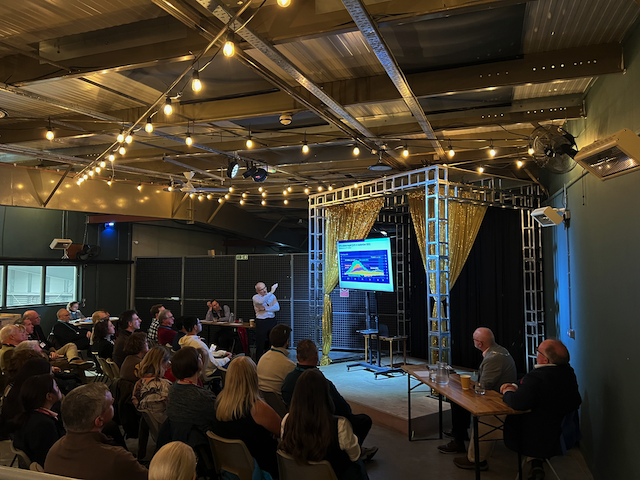
Welcome and Charity Spotlight
Attendees assembled in Rooster’s Taproom, enjoying drinks and conversations, before moving upstairs to the Sample Room for the meeting proper.
Chamber President Phill Holdsworth welcomed attendees, before introducing Ian Fozard, Rooster’s Chairman, who briefly spoke about the brewery’s history and journey in business to date. Ian highlighted that the brewery moved to the current site six years ago, and brews around 2.2 million pints of beer annually. As part of its expansion, Rooster’s acquired the former Daleside Brewery 18 months ago, retaining all employees. Ian ended by noting that the venue is available for private hire, and highlighting that the venue also hosts a variety of events each month, including music and comedy nights.
Time Together, the Chamber’s President's Charity of the Year featured in this month’s charity spotlight. Time Together supports disabled and autistic people and individuals with learning disabilities to live life well. They achieve this predominantly by providing one-to-one support to improve people's independence and well-being in their community, but also run a multitude of clubs, activities, events, trips, and other opportunities. Representing the charity, Louise and Jo highlighted several community activities, including a free and inclusive Pop Power Fitness class, a "Community Cuppa" held on the last Tuesday of each month, and a creative club. The charity recently held an art exhibition at Harrogate Library and hosted an “allotment feast” with Harrogate College; this featured a menu based on produce grown in the charity’s allotment. Looking ahead, Time Together are organising an abseiling event next year. Louise and Jo highlighted their plea for businesses to act as clothing donation stations; good quality second hand clothing provides income for the charity and contributes to local recycling efforts.
Bank of England Economic Briefing (Paul Mount)
The main presentation of the evening was delivered by Paul Mount, the Bank of England’s Deputy Agent for Yorkshire and the Humber. Paul opened by providing an overview of the Bank's dual mission of monetary and financial stability, noting that this is set by the government. He explained that the Bank Rate is the single lever used to influence demand and manage inflation. The government sets the inflation target at 2% CPI (Consumer Price Index). Paul stressed that while inflation may be returning to target, the price level remains much higher than it was before the recent economic shocks.
Paul explained that the economy is currently weak, with underlying GDP growth being pretty flat. Growth is predicted to reach only 1.8% in 2028, which is significantly below the 2% to 2.5% that governments typically aim for. Paul noted that this weakness is reflected in business conversations, with very few firms reporting strong demand and many being cautious on investment and hiring.
Inflation was reported at 3.8% in September of this year, with the forecast predicting it will gradually return to the 2% target by the end of 2026. The forecast is based on the financial markets’ expectation that interest rates will likely level out and stay at 3.5% over the next three years, down from the current 4%. Paul clarified that the Bank is cautious about cutting rates too quickly, as rates must remain high enough for long enough to bring inflation expectations down.
A Q&A session addressed the following areas:
Pessimistic Interest Rates: A member questioned why the nominal interest rate was expected to stay at 3.5% even when inflation is forecast to hit 2%, suggesting this seemed overly pessimistic. Paul explained this reflects the concept of a neutral rate of interest, meaning a 1.5% real return on savings, which is not considered excessive in a normally functioning economy. He noted the Bank's actions cannot address income inequality; monetary policy is a blunt tool.
Government Consultation / Budget: When asked what would constitute a "good budget change" , Paul diplomatically stated that long-term prosperity comes from structural reforms, such as better infrastructure and a better trained workforce. He suggested that tax rises (which the press predicts) would likely lead to a lower demand scenario.
Cause of High Inflation: When asked why the Bank let inflation get so high, Paul explained that initial global shocks (Covid, Russia / Ukraine conflict) were beyond the Bank’s control. The high interest rate's role is to manage the secondary effects, such as people hiking wages and prices (inflation persistence).
Household Savings: A question was raised about the high level of cash in business and household accounts. Paul confirmed that the household savings rate is currently high, which reflects caution and a need for an emergency buffer following recent economic shocks.
Long-Term Debt Impact: When asked about the impact of the nation theoretically paying off its debt, Paul confirmed that increased saving and debt repayment would lead to a weaker economy in the short term, but stressed the importance of sustainable and affordable borrowing.
Pre-Budget Tax Planning and Business Resilience (John Garbutt)
Paul’s economic analysis was powerfully complemented by practical guidance from John Garbutt, Director at DSC Chartered Accountants and HDCC Honorary Treasurer. John’s segment began with a theatrical entrance (dressed as the Grim Reaper!) to underscore the tax uncertainty facing businesses.The presentation also called for audience participation with a game of Tax Bingo, where potential upcoming tax changes were shouted out.
John’s talk focused on translating high-level uncertainty into clear action for business owners:
Tax Planning Strategy: He stressed that tax planning should be a long-term strategy, not a knee-jerk reaction to the Budget.
Political Uncertainty: John highlighted that political uncertainty causes "paralysis" for business investment, as no one wants to invest.
Allowance Utilisation: He strongly encouraged attendees to review their situation and (if they were going to do so anyway), make use of existing tax-free allowances for Inheritance Tax (IHT), Capital Gains Tax (CGT), and consider declaring dividends before the Budget date, as tax rates are unlikely to come down.
Income Tax: Assuming Income Tax rates will go up, he suggested considering the timing of bonuses before the end of March and advised that if dividend tax rates don't move, there might be a review on whether to incorporate a business.
Record Keeping: He noted that good record keeping for gifting out of income is essential, as this rule might have tax implications.
Professional Advice: John emphasised the critical need for businesses to engage professional advisors (accountants, pension advisors, etc.) to assess their position and avoid costly mistakes caused by political uncertainty.
Member News & Meeting Conclusion
The meeting concluded with a new member introduction, as well as member news:
New member, Lily Bell (Rise Wealth) introduced her firm, specialising in workplace pension schemes and long-term financial planning for SME owners.
Charlotte Gale (Charlotte Gale Photography) promoted her corporate personalisation service for calendars and cards.
Michael White (St. Michael’s Hospice) promoted a 2026 calendar fundraiser.
Kate Rogata (Supporting Older People) announced their Business Champions Campaign, seeking ongoing support from local businesses for their services.
Colleen Gruenwald (Alana Care Solutions) advertised a networking event for support workers in the community.
The evening concluded with final remarks from President Phill and Chief Executive Martin Mann. They reinforced the importance of the Chamber's role as a vital conduit, representing the views of local businesses to regional leaders and bodies like North Yorkshire Council.
Attendees are strongly encouraged to provide their feedback from this meeting via the Mentimeter survey using code 7882 1584. The input gathered is used by the Chamber Management Team to directly inform the planning of future meeting subjects.
Members were also alerted to an upcoming limited-capacity Post-Budget Roundtable on the 28th November with Tom Gordon MP. This exclusive breakfast event is designed for members to provide immediate feedback on the Budget announcements, which Tom Gordon will convey directly to Parliament. Members will soon receive details about this event via email.
Before the meeting drew to a close, President Phill took a moment to acknowledge and thank Ian Fozard and the Rooster's team for their excellent hospitality and for taking good care of the attendees. He also thanked the speakers and attendees for coming.
